Dear SUMO Development Team,
I am currently working on a traffic simulation project using Eclipse SUMO and have a question regarding the multi-entry-exit detector (E3) and how to properly filter specific vehicle paths.
Problem Description:
At a specific intersection, I have two types of vehicles passing through a left-turn movement:
Green Path (Target): Vehicles that make a direct left turn.
Red Path (Unwanted): Vehicles that pass through the intersection, make a U-turn or detour down the road, and eventually merge into the same exit lanes, thereby triggering the same E3 detector.
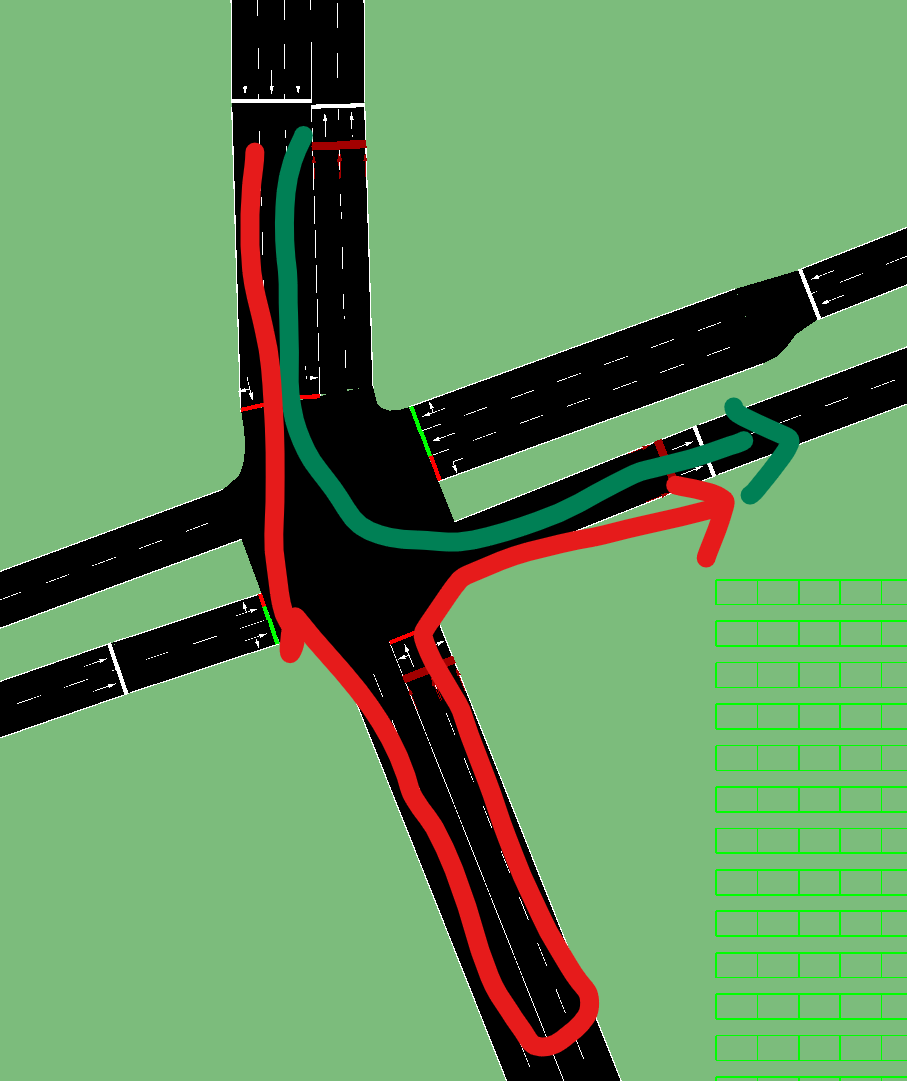
Since both paths share the same entry and exit lanes (or end up at the same E3 exit), the E3 detector counts the red-path vehicles as part of the normal left-turn movement, which distorts my performance data (speed and travel time).
What I have tried:
I attempted to use the nextEdges attribute to force the E3 detector to only capture vehicles following the exact sequence of the green path. However, whenever I define nextEdges, the E3 output consistently returns -1 (no data), even though the vehicles' routes in my .rou.xml file contain those exact edges.
My Questions:
Is nextEdges the correct attribute to filter out detouring/U-turning vehicles (the red path) when their final exit lanes are identical?
If so, what is the exact mechanism or syntax required for nextEdges when dealing with OSM-imported networks that consist of multiple sub-edges? Why does it usually result in -1?
Is there a recommended best practice in SUMO to separate or filter out these overlapping/detouring trajectories within an E3 detector without causing data failure?
Any advice or guidance would be greatly appreciated. Thank you for your time and support!
Best regards,
Tony