[Date Prev][Date Next][Thread Prev][Thread Next][Date Index][Thread Index] [List Home]
Re: [sumo-user] Modelling a complex signalized intersection with multiple TLS controllers - best approach?

Hello,
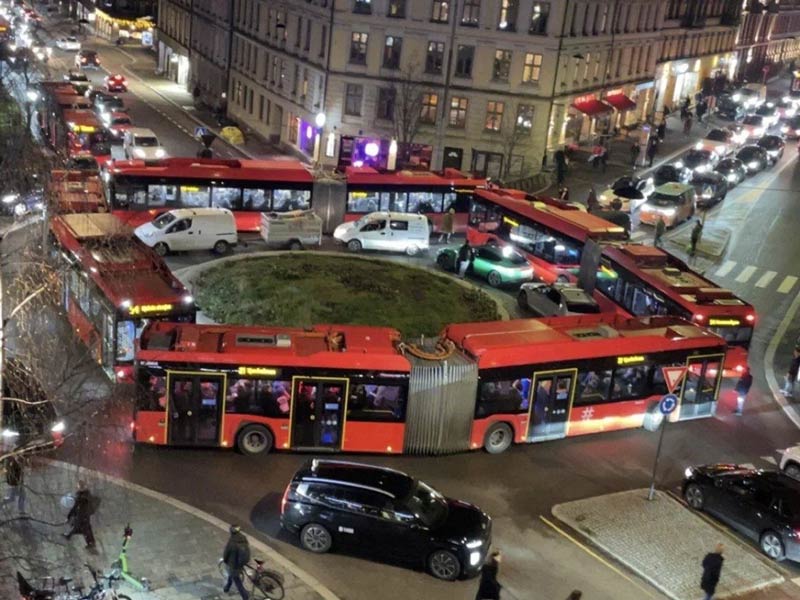
roundabouts have the curious property of being able to "deadlock" if too many vehicles are allowed to enter.
You may take https://oddstuffmagazine.com/wp-content/uploads/2025/11/It-happened-again.jpg as the illustration of an extreme case.
Unsignalized roundabouts usually avoid this situation by giving right-of-way to the vehicles already inside which serves to balance inflow and outflow.
However, for signalized roundabouts a jam on any of the downstream edges or even a badly configure signal plan could quickly result in deadlock. In reality, roundabouts use controllers, specifically designed to prevent this but the default controller cannot do this.
Any of the following things could be done for mitigation :
- limit the maximum duration for phases that permit inflow (this do not require a joint controller and are quite feasible if each arm has it's own controller)
- design the phases for a minimum number of interruptions within the roundabout (fairly easy with a fixed controller but should be done with a joint controller if you want actuation)
- use custom switching rules that prevent inflow if the number of cars inside the roundabout becomes to high: https://sumo.dlr.de/docs/Simulation/Traffic_Lights.html#type_actuated_with_custom_switching_rules

With regard to using/avoiding inner lanes of a multi-lane roundabout:
The cars in SUMO try to avoid too many lane changes and thus prefer the outside lanes in a roundabout
If the road structure is recognized as a roundabout, there is a dedicated behavioral adaptation to use the inside lanes for cars that stay longer inside (i.e. more than a quarter turn).
Since the intersection in your screenshot is quite complex and not a typical roundabout, it could be that it isn't even recognized so the behavioral adaptation doesn't get activated. You can try right-click on any component junction and pick "select roundabout" to see whether the whole circle gets highlighted in blue.
You can override the classification by loading a patch file: https://sumo.dlr.de/docs/Networks/PlainXML.html#roundabouts 

Either way, getting this work nicely will likely require manual tuning of the connection layout and the signal plans because the default heuristics do not perform well at this kind of structure.

regards,
Jakob

Am Fr., 17. Apr. 2026 um 15:04 Uhr schrieb Gabriel García Casa via sumo-user <sumo-user@xxxxxxxxxxx>:
Good afternoon everyone,

I am building a complex intersection that is causing a complete traffic collapse and I would like advice on the correct modelling approach. I am using a network imported from OSMWebWizard, SUMO version 1.25

As seen in the images, the intersection is a large roundabout with islands and multiple entry/exit points, the TLS are defined in the same position as reality and are 'actuated'. The current SUMO model has each junction imported as a separate TLS (img. 2). 

I have already tried joining all TLS nodes under a single controller using the 'Join' function in netedit and resetting the program, but the collapse persists.

Additionally, I am observing a lane distribution problem: vehicles entering the roundabout from the bottom approach are concentrating on the rightmost lanes instead of distributing across all available lanes. This is likely related to the downstream connections only allowing continuation from those lanes, but I would like to confirm whether this is a connection issue or a lcStrategic/lcContRight issue in the vType definition.

I have the following questions regarding the issue:

1. After joining all TLS under a single controller and resetting the program, the auto-generated phases still cause collapse. What is the recommended approach to manually define the phase coordination between entry signals and interior circulation signals for a roundabout of this complexity?

2. Regarding the lane distribution problem at the bottom entry: should this be fixed by correcting the downstream connections in netedit, or by tuning vType lane-change parameters (lcStrategic, lcContRight)? Or both?

3. Are there specific junction modelling issues that are commonly wrong in roundabouts with TLS after OSM import that I should systematically check?

4. Would it make more sense to remove the TLS from the interior nodes of the roundabout and keep signals only at the external entry/exit points, using priority rules for the internal circulation?

I am happy to share the network file, TLS program XML, or any additional files if that would help diagnose the issue.  

Thank you very much in advance.
Gabriel

_______________________________________________
sumo-user mailing list
sumo-user@xxxxxxxxxxx
To unsubscribe from this list, visit https://www.eclipse.org/mailman/listinfo/sumo-user

Back to the top